Table of Contents
ToggleYour gutters do one job, but they do it relentlessly: channeling water away from your roof and foundation before it causes damage. When they’re working, nobody thinks about them. When they’re not, you’re looking at foundation cracks, basement floods, and siding rot. Rain gutter maintenance isn’t glamorous, there’s no dramatic before-and-after reveal, but it’s arguably the most important preventative work a homeowner can do. This guide walks you through inspecting, cleaning, and maintaining gutters so you avoid costly repairs down the line. Whether you’re tackling it yourself or deciding when to call a gutter cleaning service, you’ll find practical advice for every season.
Key Takeaways
- Rain gutter maintenance prevents expensive foundation damage ($5,000–$25,000 in repairs) and protects your home’s structural integrity.
- Clean gutters twice yearly—once in late fall and once in late spring—or more frequently if large trees surround your home.
- Inspect gutters after heavy rain for sagging sections, rust, gaps, and water flow to catch problems before they escalate.
- Common gutter problems like sagging, leaking joints, and rust require different solutions: tighten fasteners, apply sealant, or replace sections.
- Gutter guards, downspout extensions, and tree trimming are cost-effective preventative measures that reduce maintenance frequency and protect your foundation.
- Whether you tackle gutter cleaning yourself or hire a professional service, the modest investment now saves thousands in emergency repairs later.
Why Regular Gutter Maintenance Matters
Gutters protect your home’s most vulnerable asset: its foundation and structural integrity. Water that overflows or backs up behind gutters works its way into fascia boards, soffits, and eventually the interior walls. Over time, this moisture creates conditions for rot, mold, and insect damage.
The Cost of Neglected Gutters
Neglected gutters lead to expensive problems. Foundation damage alone can cost $5,000 to $25,000 to repair, depending on severity. Fascia and soffit replacement runs $1,000 to $3,000. Basement waterproofing can exceed $10,000. A gutter cleaning service or a few hours of your own labor costs a fraction of that. The math is simple: spend a weekend twice a year, or spend tens of thousands later.
Beyond dollars, clogged gutters create safety hazards. Standing water becomes a breeding ground for mosquitoes. Ice damming in winter can pull gutters away from the eaves, creating dangerous hanging icicles. Roof leaks develop quietly, and by the time you notice water stains, the damage is already spreading behind walls.
When to Inspect and Clean Your Gutters
Most gutters need cleaning twice yearly: once in late fall after leaves drop, and once in late spring after spring storms. If you’re surrounded by large trees, bump that to three or four times per year. The goal is removing leaves, twigs, and sediment before they compact into a dam that traps water.
Inspect gutters after heavy rain to see if water is flowing freely and draining properly at downspouts. Sagging sections indicate standing water or gutter fastener failure. Visible rust or corrosion on steel gutters signals age. Gaps between gutter and fascia mean fasteners have loosened and the gutter is pulling away, a structural red flag.
Don’t wait for visible problems. Regular inspections catch issues before they escalate. A $150 gutter cleaning service every few months beats emergency foundation repairs.
Step-by-Step Gutter Cleaning Process
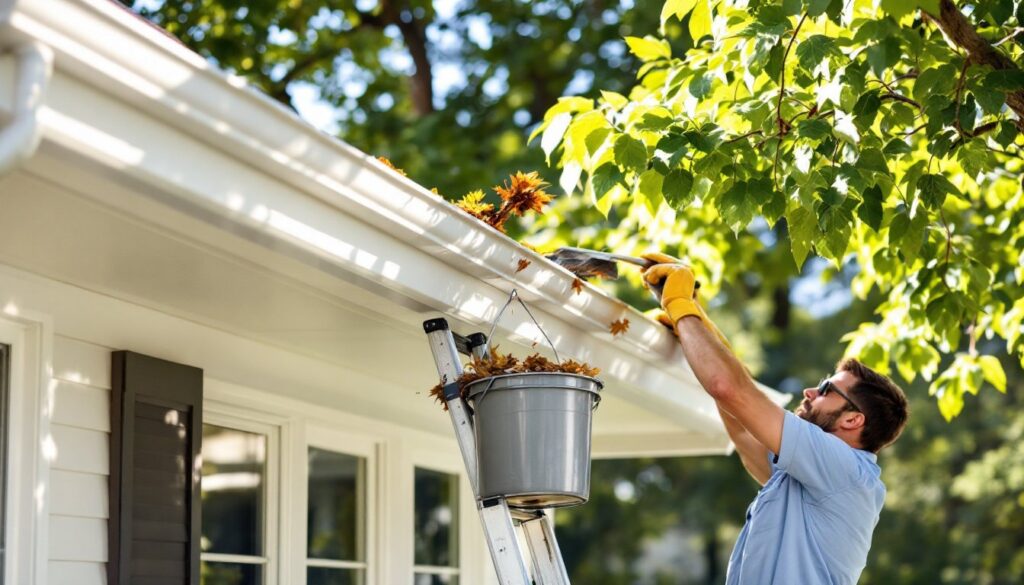
Before starting, gather your materials: a sturdy ladder (extension ladders work best for two-story homes), work gloves (leather or thick rubber, you’re digging through decomposing leaves), a gutter scoop (a plastic or metal scoop shaped to match gutter curvature), a 5-gallon bucket, and safety glasses. Professionals running a gutter cleaning service use the same tools: the only difference is experience and speed.
Safety first: Set your ladder on level ground, never on a slope or uneven surface. Wear non-slip shoes. Have someone stabilize the ladder if possible. Never lean beyond arm’s reach or twist your spine while balancing on a rung.
- Position your ladder below the gutter section you’re cleaning, stabilizing it firmly.
- Scoop out leaves and debris, working from higher sections toward downspouts. Use your gutter scoop to push material into the bucket.
- Once loose debris is removed, flush the gutter with a garden hose to push out fine sediment and confirm water flows freely.
- Check that downspout outlets are clear. If water doesn’t drain after flushing, the downspout is clogged, use a plumbing snake or pressure washer to clear it.
- Move your ladder along the line and repeat, working section by section.
- Inspect gutter fasteners and joints for gaps or separation. Loose fasteners need tightening: gaps wider than 1/8 inch usually indicate the gutter is pulling away and may need professional repair.
Common Gutter Problems and Quick Fixes
Sagging gutters are the most visible problem. They occur when fasteners loosen or gutter hangers corrode. If sagging is slight, you might tighten fasteners yourself using a drill and appropriately sized bolts (typically 3/8-inch bolts spaced 24 inches apart). If sagging is severe or if the gutter is physically dented, replacement is safer than repair. A section of five-inch K-style aluminum gutter runs $10 to $20 per linear foot installed: vinyl costs slightly less but is less durable.
Leaking joints happen where two gutter sections meet. If the leak is small, clean the joint thoroughly, allow it to dry, and apply a gutter sealant (silicone or polyurethane, not caulk, it’s more flexible). If the joint leaks again within a year, the gutter may be deteriorating and section replacement is wiser than recurring patch jobs.
Rusted-through gutters on older steel systems can’t be sealed, they need replacement. Aluminum gutters rarely rust: copper is corrosion-resistant but pricey ($25 to $40 per linear foot installed). For most DIYers tackling a gutter cleaning service mindset, preventing rust through regular cleaning is more practical than managing corrosion.
Preventative Solutions for Long-Term Protection
After cleaning, consider protective measures. Gutter guards, mesh or foam inserts that let water through while blocking leaves, reduce cleaning frequency. They’re not maintenance-free (debris still accumulates on top), but they do extend the time between cleanings. Expect to pay $1,500 to $3,000 for professionally installed guards on an average home. Budget options like stick-on foam cost $100 to $300 and work adequately if you’re willing to rinse them occasionally.
Keep downspout extensions 4 to 6 feet from the foundation to direct water away from the house. If your downspouts end too close to the foundation, water pools there and leaks into basements. Flexible downspout extensions cost $15 to $30 and make a measurable difference.
Trim tree branches overhanging the roof. This reduces leaf accumulation and improves air circulation, which prevents mold and ice dams. It also reduces weight on your gutter fasteners, a real benefit if you have large oaks or maples overhead. Regional gutter cleaning guides, like those for gutter cleaning in Hickory, NC or gutter cleaning in Indianapolis, emphasize trimming because tree coverage varies by location.
For those in areas with severe weather, upgrading to larger gutters helps. Standard five-inch K-style gutters handle about 0.96 inches of rain per hour: six-inch gutters can manage 1.5 inches per hour. If you live in a high-rainfall region like the Pacific Northwest (think gutter cleaning in Gig Harbor), larger gutters are worth the investment.
Resources like Family Handyman provide step-by-step repair tutorials for the confident DIYer, while Today’s Homeowner offers seasonal maintenance checklists. For visual learners, detailed cleaning guides break down ladder safety and technique.
Conclusion
Rain gutter maintenance isn’t complex, but it is non-negotiable. Clean gutters twice a year, inspect them seasonally, and act quickly on sagging or leaking sections. Whether you handle the work yourself or hire a gutter cleaning service, the cost is trivial compared to the damage prevented. Your roof and foundation will thank you for the attention.